
 EN
EN


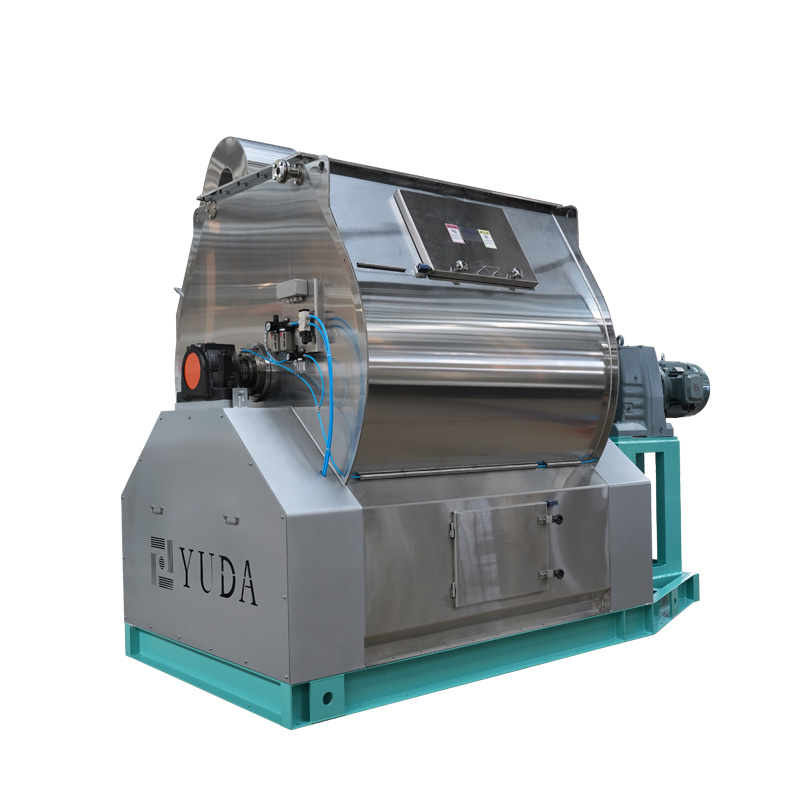
How to Reduce Mixing Time and Improve Feed Mixer Efficiency?
How Advanced Feed Mixing Equipment Improves Production Efficiency and Feed Quality
Introduction
Selecting efficient feed mixing equipment plays an important role in improving productivity and maintaining consistent feed quality in modern animal feed production.
The mixing process directly affects:
- Feed uniformity
- Pellet quality
- Production capacity
- Energy consumption
- Operating costs
For feed mills producing poultry feed, livestock feed, aquatic feed, and premix products, reducing mixing time while maintaining high mixing accuracy is a key challenge.
Traditional mixing machines may require longer operating cycles, consume more energy, and struggle with uneven material distribution.
Modern industrial feed mixers, especially double shaft paddle mixers, are designed to achieve faster mixing, better uniformity, and higher production efficiency.
YUDA Machinery provides advanced feed mixing solutions, including the SSHJ Series Feed Double‑Shaft Paddle Mixer, which is widely used in medium and large‑scale feed production lines.
Why Is Mixing Time Important in Feed Production?
The Impact of Mixing Efficiency on Feed Quality
The mixing process is one of the most important stages in a complete animal feed production line.
During mixing, different ingredients must be evenly distributed, including:
- Corn
- Soybean meal
- Wheat
- Bran
- Minerals
- Vitamins
- Additives
If the mixing time is too short:
- Ingredients may not be evenly distributed
- Nutritional consistency decreases
- Feed quality becomes unstable
If the mixing time is too long:
- Energy consumption increases
- Production capacity decreases
- Operating costs rise
Therefore, the goal of modern feed mixer machines is not simply longer mixing time, but achieving the highest uniformity within the shortest possible cycle.
What Factors Affect Feed Mixer Efficiency?
- Mixer Structure and Mixing Principle
The structure of a feed mixing machine directly determines mixing performance.
Different mixer designs provide different mixing effects.
Common types include:
Ribbon Feed Mixer
Suitable for:
- Mixing of high moisture content materials ‑ fermentation materials
- Small and medium feed production
Advantages:
- Simple structure
- Stable operation
- Cost‑effective solution
Single Shaft Paddle Mixer
Suitable for:
- Mixing of powders with good fluidity ‑ premix
- Various feed formulas
Advantages:
- Efficient material movement
- Good mixing performance
Double Shaft Paddle Mixer
Suitable for:
- Mixing of powdery, granular, flaky, blocky, and viscous materials
- Large‑scale production lines
Advantages:
- Faster mixing speed
- Higher uniformity
- Lower mixing time
Among these solutions, the double shaft paddle mixer is widely recognized as an efficient solution for industrial feed production.
How Does a Double Shaft Paddle Mixer Reduce Mixing Time?
Advanced Mixing Principle for Higher Efficiency
The double shaft paddle mixer uses two parallel rotating shafts equipped with specially designed paddles.
During operation:
- Materials are lifted and circulated
- Different ingredients move in multiple directions
- Convective and shearing effects improve mixing performance
This creates a three‑dimensional mixing process, allowing materials to achieve uniform distribution in a shorter time.
Compared with traditional mixing equipment, the double shaft paddle mixer can provide:
- Shorter mixing cycles
- Better material circulation
- Higher production efficiency
YUDA SSHJ Series Feed Double‑Shaft Paddle Mixer
High‑Efficiency Feed Mixing Solution for Modern Feed Mills
YUDA SSHJ Series Feed Double‑Shaft Paddle Mixer is designed for customers requiring high‑performance animal feed mixing equipment.
The machine adopts a horizontal double‑shaft paddle structure, which improves mixing efficiency and reduces processing time.
Main Features of SSHJ Feed Mixer
- High Mixing Uniformity
The specially designed paddle structure creates strong material circulation.
Advantages:
- Uniform ingredient distribution
- Reduced material separation
- Stable feed quality
This makes the SSHJ mixer suitable for:
- Poultry feed
- Livestock feed
- Aquatic feed
- Short Mixing Cycle
Improving mixing speed helps feed factories increase production capacity.
The SSHJ double shaft paddle mixer provides:
- Rapid material movement
- Efficient mixing process
- Reduced waiting time between production stages
This helps improve the overall efficiency of the complete feed production line.
- Low Material Residue
Material residue inside the mixer affects:
- Feed formula accuracy
- Cleaning efficiency
- Production continuity
The SSHJ series adopts optimized internal design to reduce material accumulation and improve discharge performance.
SSHJ Series Feed Double‑Shaft Paddle Mixer Technical Reference
表格
| Model | Effective volume(M³) | Power(kw) | Capacity(kg/batch) | Dimensions(mm) | Weight(kg) |
|---|---|---|---|---|---|
| SSHJ0.2 | 0.2 | 4 | 100 | 1600*1425*1150 | 1000 |
| SSHJ0.5 | 0.5 | 5.5/7.5 | 250 | 1800*2000*1500 | 1760 |
| SSHJ1 | 1 | 11/15 | 500 | 2000*2500*1400 | 2405 |
| SSHJ2 | 2 | 18.5/22 | 1000 | 2820*2345*2130 | 4320 |
| SSHJ3Z | 3 | 22/30 | 1500 | 2650*2800*2310 | 4500 |
| SSHJ4Z | 4 | 30/37 | 2000 | 2890*3070*2450 | 6260 |
| SSHJ6Z | 6 | 37/45 | 3000 | 3530*2980*2460 | 7500 |
| SSHJ8Z | 8 | 45/55 | 4000 | 3800*2980*2400 | 8500 |
(Final capacity depends on material characteristics, production requirements, and complete production line design.)
How to Improve Feed Mixer Efficiency?
- Optimize Mixer Loading Rate
Proper loading capacity is important for achieving the best mixing performance.
Too little material:
- Reduces mixing efficiency
- Increases production cost
Too much material:
- Limits material movement
- Reduces mixing uniformity
The ideal solution is operating the mixer within the recommended filling range.
- Select the Right Mixer Capacity
Choosing the correct feed mixer capacity helps avoid production bottlenecks.
The selection should consider:
- Feed mill output
- Batch size
- Mixing cycle
- Pellet mill capacity
- Future expansion requirements
For example:
A large commercial feed mill requires a higher‑capacity mixer to continuously supply material to pelletizing equipment.
- Improve Material Preparation Before Mixing
Mixing efficiency is also affected by upstream processes.
Before mixing:
- Particle size should be controlled
- Raw materials should be properly ground
- Ingredients should be accurately dosed
A well‑designed:
- Feed hammer mill
- Automatic batching system
- Feed mixer
can significantly improve overall production performance.
Feed Mixer Applications in Different Industries
Poultry Feed Production
Poultry feed requires:
- High mixing accuracy
- Stable nutritional distribution
- Consistent pellet quality
Feed mixers help ensure balanced feed formulas for:
- Chicken feed
- Broiler feed
- Layer feed
Livestock Feed Production
Livestock feed often contains different raw materials.
Applications include:
- Pig feed
- Cattle feed
- Sheep feed
The mixer must provide:
- Strong mixing ability
- Stable operation
- High production efficiency
Aquatic Feed Production
Aquatic feed requires precise ingredient distribution.
High‑performance feed mixing equipment helps achieve:
- Uniform additives distribution
- Stable nutritional content
- Better pellet processing performance
Common Problems That Reduce Feed Mixer Efficiency
- Excessive Mixing Time
Problem:
Long mixing cycles reduce production capacity.
Solution:
Choose a high‑efficiency mixer with optimized paddle structure.
- Uneven Mixing
Problem:
Poor ingredient distribution affects feed quality.
Solution:
Use suitable mixing equipment according to material characteristics.
- Incorrect Mixer Capacity
Problem:
The mixer becomes a bottleneck in the production line.
Solution:
Select capacity based on:
- Production output
- Batch requirements
- Complete line design
Why Choose YUDA Feed Mixing Equipment?
YUDA provides professional feed mixing solutions for global feed manufacturers.
The company offers:
- Feed mixer design
- Equipment manufacturing
- Complete feed production line solutions
- Installation support
- Technical service
YUDA SSHJ Series Double‑Shaft Paddle Mixer is designed for customers requiring:
- Higher production efficiency
- Shorter mixing time
- Better feed quality consistency
FAQ: Feed Mixer Efficiency
Q1: How can I reduce feed mixing time?
You can reduce mixing time by selecting efficient mixing equipment, optimizing material preparation, and using a suitable mixer capacity.
Q2: What type of feed mixer provides the fastest mixing?
Double shaft paddle mixers are commonly used for high‑efficiency feed production because they provide strong material circulation and excellent mixing performance.
Q3: What is the advantage of a double shaft paddle mixer?
The main advantages include:
- Faster mixing
- Better uniformity
- Lower residue
- Higher production efficiency
Q4: How do I choose a feed mixer for my production line?
Selection should consider:
- Production capacity
- Feed type
- Material characteristics
- Mixing requirements
- Downstream equipment capacity
Conclusion
Improving feed mixer efficiency requires more than increasing machine speed.
The right solution combines:
- Advanced mixer structure
- Proper equipment selection
- Optimized production processes
- Correct capacity matching
The YUDA SSHJ Series Feed Double‑Shaft Paddle Mixer provides an efficient solution for modern feed manufacturers looking to reduce mixing time, improve feed quality, and increase production efficiency.
With professional feed mixing equipment and complete feed production solutions, YUDA helps customers build reliable and efficient animal feed production systems.
Written by:
YUDA Machinery Engineering Team
Based on years of experience in feed machinery manufacturing, equipment design, overseas project installation, and complete feed production line solutions.
Table of Contents
-
How Advanced Feed Mixing Equipment Improves Production Efficiency and Feed Quality
- Introduction
- Why Is Mixing Time Important in Feed Production?
- What Factors Affect Feed Mixer Efficiency?
- How Does a Double Shaft Paddle Mixer Reduce Mixing Time?
- YUDA SSHJ Series Feed Double‑Shaft Paddle Mixer
- How to Improve Feed Mixer Efficiency?
- Feed Mixer Applications in Different Industries
- Common Problems That Reduce Feed Mixer Efficiency
- Why Choose YUDA Feed Mixing Equipment?
- FAQ: Feed Mixer Efficiency
- Conclusion
