
 EN
EN


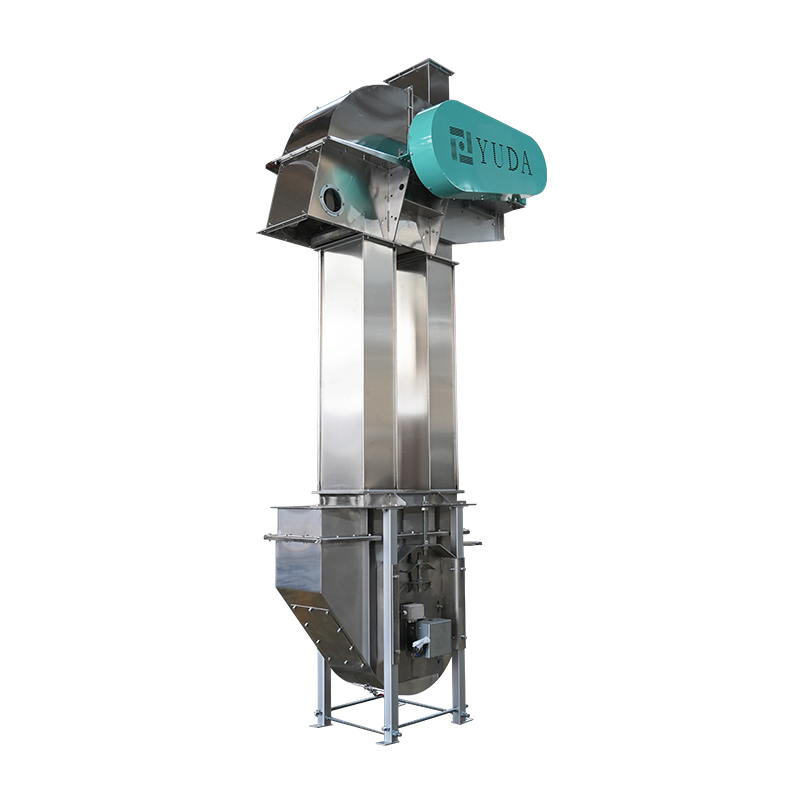
Bucket Elevator Selection Guide | Yuda Machinery Engineering Team
A bucket elevator that works well for dry grain may not be the best choice for fine powder, fragile pellets, abrasive materials, or products with high moisture content. The material determines how the buckets should collect and discharge the product, which lifting structure may be suitable, and what capacity the equipment can realistically achieve. Choosing a bucket elevator based only on tons per hour can therefore lead to material breakage, residue, blockages, premature wear, or unstable operation.
The practical approach is to identify the material's physical characteristics first, then match the bucket material, elevator structure, capacity, and lifting height to the ctual application. This guide explains the key material factors to check, how to compare Yuda's TDTG series bucket elevator models, and what to confirm before requesting a quotation.
The short answer: Choose a bucket elevator based on material form, bulk density, moisture, fragility, abrasiveness, required throughput, and lifting height. For grain bucket eleator applications, also consider whether preserving whole kernels is important. Confirm the final configuration with the manufacturer using your actual material and operating conditions.
1. Why Material Characteristics Matter
A bucket elevator uses a series of buckets attached to a moving belt or chain to lift bulk materials vertically. Although the basic principle is similar across different models, the way a material enters the bucket, remains inside it, and leaves at the discharge point can vary significantly with its physical properties.
For example, dry grain may flow readily into a bucket, while damp powder may form lumps or adhere to internal surfaces. Fragile kernels can crack if they experience excessive impact, while abrasive materials can accelerate wear on buckets and other contacting components. These differences mean that the same bucket elevator conveyor configuration may not deliver the same performance with every product.
Before selecting a bucket conveyor system, describe the material in detail rather than identifying it only as “grain,” “feed,” or “powder.” Its moisture content, particle size, bulk density, flowability, and sensitivity to impact are all relevant to the selection process.
Key Material Characteristics to Check
|
Material characteristic |
Why it matters |
What to confirm |
|
Material form |
Influences bucket filling and discharge |
Whole grain, powder, pellets or granules |
|
Bulk density |
Affects mass throughput at a given volumetric flow |
Actual bulk density in kg/m³ or t/m³ |
|
Moisture content |
May affect flowability, adhesion and residue |
Normal and maximum moisture |
|
Fragility |
Determines how carefully impact and transfer points must be managed |
Acceptable breakage and fines limits |
|
Abrasiveness |
Influences wear on buckets and contacting components |
Hardness and abrasive content |
|
Impurities |
May increase the risk of blockage or component damage |
Stones, metal fragments, fibers and other contaminants |
2. Match the Bucket Elevator to the Type of Material
2.1 Grain and Other Free-Flowing Granular Materials
Dry corn, wheat, rice, and other free-flowing grains are common applications for a grain bucket elevator. These materials generally enter the buckets readily, but the equipment still needs to be matched to the required capacity, particle characteristics, and discharge arrangement.
If the material must remain intact, pay attention to the feeding point, bucket loading, belt or chain speed, and discharge conditions. Excessive impact or unsuitable operating settings may increase broken kernels and fines, even when the elevator has sufficient rated capacity.
When comparing bucket elevator manufacturers, ask whether the proposed model and bucket configuration are suitable for your specific grain, and whether a sample test is recommended for applications with strict grain-integrity requirements.
2.2 Fine Powder and Meal
Fine powder and feed meal behave differently from whole grain. Particle size, bulk density, moisture, and dust generation can affect bucket filling, material retention, and discharge performance. A bucket elevator conveyor intended for granular products should not automatically be assumed suitable for every powder.
For fine materials, discuss the particle-size distribution, moisture level, bulk density, and tendency to adhere or form lumps with the manufacturer. The bucket design, elevator speed, feeding arrangement, and dust-control requirements should be reviewed together.
Where combustible dust may be present, assess the material's actual dust hazards and the installation's applicable safety requirements. Do not assume that a standard bucket elevator is suitable for a combustible-dust environment without confirming the required protective configuration.
2.3 Pellets and Processed Feed Materials
Pellets may be more uniform than mixed raw materials, but their durability varies with formulation, moisture, diameter, and manufacturing conditions. If pellets break easily, the bucket elevator should be assessed as part of the entire conveying route rather than as an isolated machine.
Check the transfer from the upstream equipment into the elevator, the way buckets collect the pellets, and how material leaves the head section. Poorly matched operating conditions can generate fines and affect the quality of the finished feed.
For a pellet-handling application, tell the supplier the pellet diameter, typical length, bulk density, moisture content, required throughput, and acceptable level of breakage. These details provide a more useful basis for selecting a bucket conveyor system than the word “pellets” alone.
2.4 Damp, Sticky, or Agglomerating Materials
Materials with high moisture or sticky characteristics may adhere to bucket surfaces and leave residue at the discharge point or elevator base. Material accumulation can reduce effective conveying performance and increase cleaning and maintenance requirements.
Before choosing a bucket elevator for these products, confirm the normal and maximum moisture content, whether the material forms lumps during storage, and whether it tends to stick to the selected bucket material. Ask the supplier how the proposed configuration handles residue and cleaning access.
If the material is highly sticky or prone to severe agglomeration, the manufacturer should evaluate whether a bucket elevator is appropriate for the application or whether the conveying process needs to be modified. Do not rely on capacity figures alone to resolve a material-handling problem.
2.5 Abrasive Materials and Materials Containing Impurities
Abrasive particles can gradually wear buckets and other contacting components. The rate of wear depends on the material's hardness, particle shape, abrasive content, operating conditions, and the components exposed to the material.
Impurities introduce a different concern. Stones, metal fragments, fibers, or other foreign objects may interfere with normal feeding and discharge or damage equipment. The material should be inspected and the need for upstream cleaning or magnetic separation evaluated according to the actual contaminants.
For abrasive or contaminated products, discuss bucket material, wear-part replacement, inspection access, and cleaning requirements before placing an order. The most suitable configuration should be selected from the actual material conditions, not simply from the nominal capacity.
3. Choose the Right Bucket Material and Lifting Structure
Material characteristics influence not only the capacity of a bucket elevator, but also its bucket material and lifting arrangement. Yuda's TDTG-related product information lists bucket options including plastic, nylon, and metal, with different configurations available for different material properties. Belt-type, loop-chain-type, and plate-chain-type lifting arrangements are also listed as options on the relevant product range. The final combination should be confirmed for the specific model and application.
When comparing options, consider the following factors:
Bucket material: Check suitability for the material's weight, particle characteristics, and operating environment.
Lifting arrangement: Confirm that the proposed belt or chain configuration matches the required load and operating conditions.
Discharge performance: Review how the material is released from the buckets and whether residue is likely.
Wear and maintenance: Consider inspection access, replacement of wear parts, and routine cleaning.
Safety requirements: Identify any dust, operating, or site-specific hazards that require additional protective measures.
A suitable bucket conveyor is the result of matching the material, structure, and operating conditions. There is no single bucket material or lifting arrangement that should automatically be treated as the best choice for every product.
4. Match Capacity and Lifting Height to Your Actual Requirements
After assessing the material, determine the required throughput and vertical lifting height. A bucket elevator for sale should be evaluated against both requirements, because adequate capacity alone does not guarantee that the machine can reach the required discharge point.
Yuda's published TDTG series product page lists models ranging from TDTG26/13, with a stated capacity of 1–3 T/H and a maximum lift height of 20 m, to TDTG80/46, with a stated capacity of 200–300 T/H and a maximum lift height of 45 m. These are published model specifications; the appropriate capacity for a particular material and operating condition should be confirmed with the manufacturer.
Yuda TDTG Series Bucket Elevator: Selected Model Specifications
|
Model |
Capacity (m³/h) |
Max Power |
Max lift height |
Plastic Bucket(Model) |
Belt Width(mm) |
|
TDTG26/13 |
2-6 |
≤4KW |
20M |
DQ1311(0.32L)粉料 DS1311(0.56L)粒料 |
150mm |
|
TDTG26/18 |
10-15 |
≤5.5KW |
25M |
DQ1814(0.82L)粉料 DS1814(1.41L)粒料 |
200mm |
|
TDTG36/18 |
15-25 |
≤7.5KW |
30M |
DQ1814(0.82L)粉料 DS1814(1.41L)粒料 |
200mm |
|
TDTG36/23 |
20-35 |
≤11KW |
30M |
DQ2314(1.28L)粉料 DS2314(1.6L)粒料 |
250mm |
|
TDTG36/28 |
25-45 |
≤15KW |
35M |
DQ2814(1.75L)粉料 DS2814(2.01L)粒料 |
300mm |
|
TDTG40/23 |
25-40 |
≤18.5KW |
35M |
DQ2314(1.28L)粉料 DS2314(1.6L)粒料 |
250mm |
|
TDTG40/28 |
30-50 |
≤18.5KW |
40M |
DQ2814(1.75L)粉料 DS2814(2.01L)粒料 |
300mm |
|
TDTG50/23 |
50-80 |
≤22KW |
45M |
M2316(2.64L)粉料/粒料 |
250mm |
|
TDTG50/28 |
60-100 |
≤30KW |
45M |
M2816(3.3L)粉料/粒料 |
300mm |
|
TDTG60/30 |
80-135 |
≤45KW |
45M |
M3018(3.77L)粉料/粒料 |
320mm |
|
TDTG60/33 |
140-230 |
≤55KW |
45M |
M3321(6.38L)粉料/粒料 |
350mm |
|
TDTG80/46 |
250-400 |
≤75KW |
45M |
DQ4723(8.5L)粉料/粒料 DQ4726(9.9L)粉料/粒料 |
500mm |
Source: Yuda Machinery's published TDTG series product specifications. The table shows selected models, not the complete series. Confirm the latest model data and application suitability with the manufacturer.
Do not select a model simply because its maximum capacity exceeds your target. Confirm the expected peak flow, material bulk density, feeding conditions, and required lift height. If your production line handles several different materials, provide the operating details for each material rather than assuming that one nominal capacity will apply equally to all of them.
5. Common Mistakes When Selecting a Bucket Elevator
Several mistakes can lead to equipment that appears suitable on paper but performs poorly in actual production.
Mistake 1: Selecting equipment based only on capacity
Two materials can behave differently even when the required throughput is identical. Material density, moisture, particle size, and fragility should be considered alongside the rated capacity.
Mistake 2: Treating all grain and feed materials as the same
Whole grain, ground meal, and finished pellets have different physical characteristics. The supplier needs to know the actual material and its condition before recommending a configuration.
Mistake 3: Ignoring material breakage
For applications where whole kernels or finished pellets must remain intact, review the feeding, lifting, and discharge process. A suitable rated capacity does not automatically guarantee low breakage.
Mistake 4: Overlooking moisture and residue
Damp or sticky material may accumulate inside the equipment. Discuss cleaning access, residue removal, and the material's actual moisture range before ordering.
Mistake 5: Ignoring wear and contamination
Abrasive particles and foreign objects can increase wear or cause operating problems. Identify these risks early and discuss the need for appropriate bucket materials, cleaning equipment, and maintenance access.
Mistake 6: Checking capacity but not lifting height
A model may handle the required tonnage but still be unsuitable if its maximum lift height does not meet the installation requirement. Verify both parameters against the actual layout.
6. Selection Logic and Procurement Risk
Before purchasing a bucket elevator conveyor, provide the manufacturer with a complete material description. At a minimum, include:
Material name and physical form.
Particle size and bulk density.
Normal and maximum moisture content.
Fragility and acceptable breakage level.
Abrasiveness and possible impurities.
Required throughput and expected peak flow.
Vertical lifting height and discharge location.
Operating environment and any dust-related safety requirements.
Ask the supplier to confirm in writing that the proposed model, bucket material, lifting arrangement, and rated capacity are suitable for your application. Where material behavior is uncertain, discuss whether testing with a representative sample is necessary.
A quotation based only on a general description such as “grain elevator” or “feed bucket elevator” may leave important operating conditions unchecked. A more complete quotation should identify the selected model and its relevant specifications, while making clear any assumptions about the material and working conditions.
If the plant handles different materials at different times, ask whether the same configuration is suitable for all of them. Where the materials differ substantially in density, moisture, abrasiveness, or fragility, the supplier should evaluate each operating condition separately.
For feed mills, grain storage facilities, and other bulk-material handling projects, the right bucket elevator should be selected as part of the complete conveying route. The inlet equipment, elevator, discharge equipment, and receiving bin should work together without creating an avoidable bottleneck.
You can review Yuda's TDTG Series Bucket Elevator for published model specifications and discuss your material requirements with the engineering team.
7. Frequently Asked Questions (FAQ)
Q1. How do I choose a bucket elevator based on material characteristics?
Start by identifying the material form, bulk density, moisture content, particle size, fragility, and abrasiveness. Then match the bucket material, lifting arrangement, capacity, and lift height to the application. Confirm the final selection with the manufacturer using your actual operating conditions.
Q2. Can one bucket elevator handle grain, powder, and pellets?
It depends on the machine configuration and the characteristics of each material. Grain, powder, and pellets differ in flowability, density, moisture behavior, and sensitivity to impact. Ask the manufacturer to confirm whether the same bucket elevator conveyor is suitable for every material you intend to handle.
Q3. What should I consider when selecting a grain bucket elevator?
Consider grain type, bulk density, throughput, lifting height, and the required level of kernel integrity. If broken kernels and fines must be minimized, review the feeding and discharge arrangements and discuss the suitability of the proposed configuration with the manufacturer.
Q4. Does higher bucket elevator capacity always mean better performance?
No. A larger rated capacity does not automatically mean better performance for a particular material. The selected model must also match the material's properties, actual operating flow, lifting height, and installation requirements. An unsuitable configuration may still cause residue, breakage, or operating problems.
Q5. What information should I provide when requesting a bucket elevator quotation?
Provide the material name and form, bulk density, particle size, moisture content, fragility, abrasiveness, required capacity, lifting height, and installation conditions. Also identify any impurities or dust-related safety requirements. This information helps bucket elevator manufacturers evaluate the application more accurately.
Q6. Which TDTG bucket elevator model should I choose?
The appropriate TDTG model depends on the required throughput, material characteristics, and lifting height. Yuda's published model range includes capacities from 1–3 T/H for the TDTG26/13 to 200–300 T/H for the TDTG80/46, with maximum lift heights listed from 20 m to 45 m across these models. Confirm the suitable model and final specifications with Yuda based on your application.
Written by: Yuda Machinery Engineering Team
Based on experience in feed machinery manufacturing, equipment selection, and conveying-system applications.
Table of Contents
- 1. Why Material Characteristics Matter
- 2. Match the Bucket Elevator to the Type of Material
- 3. Choose the Right Bucket Material and Lifting Structure
- 4. Match Capacity and Lifting Height to Your Actual Requirements
- 5. Common Mistakes When Selecting a Bucket Elevator
- 6. Selection Logic and Procurement Risk
-
7. Frequently Asked Questions (FAQ)
- Q1. How do I choose a bucket elevator based on material characteristics?
- Q2. Can one bucket elevator handle grain, powder, and pellets?
- Q3. What should I consider when selecting a grain bucket elevator?
- Q4. Does higher bucket elevator capacity always mean better performance?
- Q5. What information should I provide when requesting a bucket elevator quotation?
- Q6. Which TDTG bucket elevator model should I choose?
