
 EN
EN


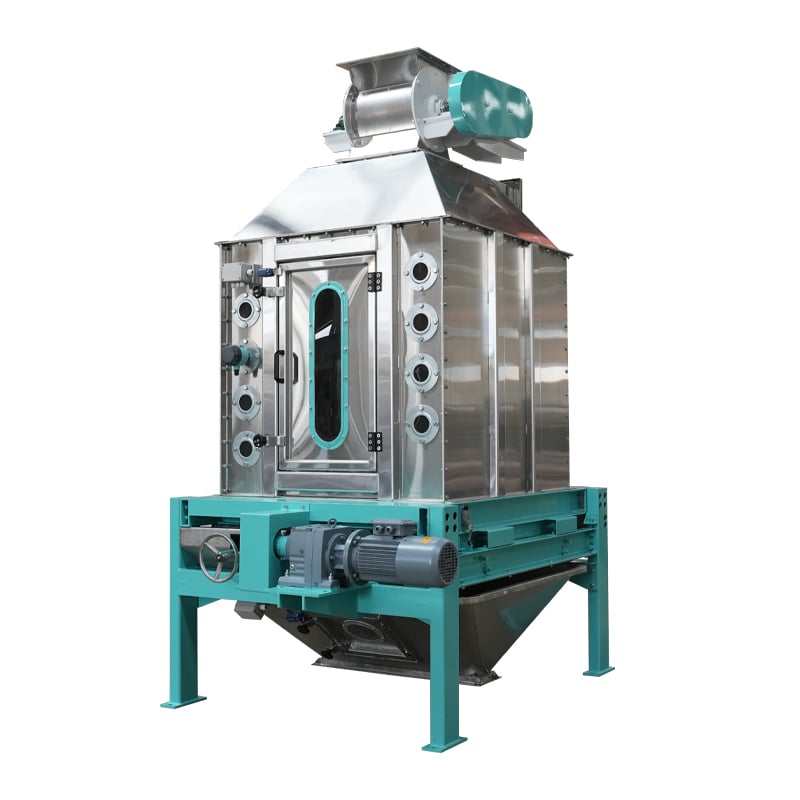
1. Introduction: Start with Production Capacity, Not Machine Size
Choosing the right counterflow cooler is an important step in building an efficient feed pellet production line. A properly selected pellet cooler helps reduce pellet temperature and moisture after pelleting, improving pellet quality, storage stability, and subsequent handling.
However, not every pellet cooling machine is suitable for every feed mill. The right choice depends on production capacity, pellet characteristics, cooling requirements, installation space, and the discharge system.
Yuda Machinery offers multiple counterflow cooler models for different production requirements. The available SKLN series covers a range of capacities, from approximately 1–2.5 T/H for the SKLN1.5 model to 30–35 T/H for the SKLN15 model. The SKLB tipping counterflow cooler is another option for specific production-line configurations.
2. Match the Cooler Capacity to Your Pellet Mill
The first step in selecting a counterflow cooler is to determine the actual output of your pellet mill. The cooler should be able to handle the production line's continuous output without creating a bottleneck.
If the pellet cooler is undersized, pellets may accumulate at the discharge point, affecting the entire production process. An oversized pellet cooling machine may increase equipment investment and occupy unnecessary floor space.
The following table provides a reference for selecting a Yuda SKLN counterflow cooler model. Actual capacity depends on material characteristics, operating conditions, and the complete production-line configuration. Confirm the final selection with the manufacturer before purchasing.
Yuda SKLN Counterflow Cooler Selection Reference
|
Model |
Slide valve discharge motor power |
Capacity |
Cooling volume |
Weight |
Length × Width × Height |
|
(kw) |
(t/h) |
(m³) |
(kg) |
mm |
|
|
SKLN1.5 |
1.5 |
1-2.5t/h |
1.5 |
980 |
2000*1400*2850 |
|
SKLN2.5 |
1.5 |
2.5-5t/h |
2.5 |
1170 |
2300*1700*3200 |
|
SKLN4 |
2.2 |
5-10t/h |
4 |
1740 |
2800*2200*3550 |
|
SKLN6 |
3 |
10-15t/h |
6 |
2004 |
3300*2200*4050 |
|
SKLN8 |
4 |
15-20t/h |
8 |
2280 |
3400*2700*4100 |
|
SKLN10 |
4 |
20-25t/h |
10 |
3000 |
3900*2700*4200 |
|
SKLN12 |
4 |
25-30t/h |
12 |
3600 |
3900*3200*4450 |
|
SKLN15 |
5.5 |
30-35t/h |
15 |
4300 |
3930*3570*5360 |
When comparing pellet coolers, do not select a model based on nominal capacity alone. Consider the pellet mill's actual output, the type of feed being processed, expected production fluctuations, and the cooling time required.
3. Choose the Right Discharge Design
The discharge system is another important factor when choosing a counterflow pellet cooler. Different discharge designs may be suitable for different pellet characteristics and production-line requirements.
The SKLN series is a standard counterflow cooler option for many feed pellet production applications. The SKLB tipping counterflow cooler provides an alternative discharge configuration for production lines where this design better matches the operating requirements.
When comparing these options, evaluate the following factors:
Pellet characteristics: Consider pellet size, durability, and susceptibility to breakage.
Discharge stability: The discharge system should support continuous operation and help prevent material accumulation.
Maintenance access: Operators should be able to inspect and maintain key components conveniently.
Production-line integration: Confirm that the cooler's discharge method is compatible with downstream conveying and screening equipment.
The best counter flow cooler is not necessarily the one with the most complex structure. It is the one that fits your production process, material characteristics, and maintenance requirements.
4. Check Cooling Performance and Pellet Quality
The main purpose of a pellet cooling machine is to remove heat and excess moisture from hot pellets after the pelleting process. A counterflow cooler uses the countercurrent movement of air and pellets to support heat and moisture transfer.
In a typical counterflow cooling process, hot pellets enter the cooler from the top, while cooling air moves upward through the pellet bed. This arrangement helps cool the pellets progressively as they move through the machine.
Under suitable operating conditions, pellet temperature at the cooler outlet may be approximately 3–5°C above ambient temperature. However, this is a reference range rather than a guaranteed result. Actual performance depends on feed formulation, pellet diameter, inlet temperature, moisture content, airflow, ambient conditions, and operating settings.
To evaluate a counterflow cooler, consider these key indicators:
Outlet pellet temperature: Check whether the cooled pellets meet your process requirements.
Moisture control: Confirm that cooling helps achieve the desired final moisture level.
Pellet integrity: Avoid operating conditions that cause excessive breakage or fines.
Operating stability: Evaluate whether the cooler performs consistently under normal production loads.
A well-matched counterflow cooler can help improve downstream handling and storage, but cooling performance should always be assessed in the context of the complete feed production line.
5. Consider Footprint, Height, and Maintenance Access
Even if a pellet cooler meets your capacity requirements, it may not be suitable if the installation space is insufficient. Before confirming an order, review the equipment dimensions, overall height, installation position, and access requirements.
For example, the reference specifications for the Yuda SKLN8 counterflow cooler list approximate dimensions of 3,400 × 2,700 × 4,100 mm and a net weight of 2,280 kg. These figures are useful for preliminary planning, but the final installation layout should be based on the confirmed equipment drawing.
When planning the installation, allow sufficient space for:
Inlet and outlet connections.
Upstream and downstream conveying equipment.
Inspection doors and observation windows.
Routine cleaning, inspection, and component replacement.
Structural support and installation access.
Do not calculate the required supporting structure based on the machine's net weight alone. The engineering plan should also account for the material held inside the cooler and other applicable loads.
A properly planned installation makes the counterflow cooler easier to operate, inspect, and maintain over the long term.
6. Common Mistakes When Choosing a Pellet Cooler
Several common mistakes can affect the performance and efficiency of a feed pellet production line.
Mistake 1: Selecting capacity based only on the pellet mill's model
The actual output of a pellet mill may vary with feed formulation, pellet size, and operating conditions. Always confirm the expected production rate before selecting a cooler.
Mistake 2: Ignoring the type of material being processed
Different feed formulations and pellet characteristics may require different cooling conditions. Share your material information with the manufacturer during the selection process.
Mistake 3: Focusing only on the purchase price
The initial price is only one part of the total cost. Energy consumption, maintenance requirements, operating stability, and integration with other equipment should also be considered.
Mistake 4: Overlooking installation and maintenance space
Insufficient clearance can make routine inspection and maintenance difficult. Review the equipment drawing and the entire production-line layout before installation.
Mistake 5: Expecting a fixed outlet temperature under all conditions
Cooling results vary with ambient temperature, pellet moisture, airflow, and other operating factors. Discuss your target outlet temperature with the manufacturer and confirm it under the expected operating conditions.
Avoiding these mistakes helps you select a pellet cooling machine that matches your production needs rather than simply choosing the largest or lowest-priced model.
7. Selection and Procurement Checklist
Before requesting a quotation for a counterflow cooler, prepare the following information to help the manufacturer recommend a suitable model.
Required capacity: What is the target output of your feed production line in tons per hour?
Pellet specifications: What are the pellet diameter, length, and type of feed?
Material conditions: What are the expected inlet temperature and moisture content?
Cooling target: What outlet temperature and final moisture level do you require?
Production-line configuration: Which pellet mill, conveyor, screener, and other equipment will connect to the cooler?
Installation conditions: What are the available floor space, building height, and maintenance clearances?
Discharge requirements: Do you have any specific requirements for discharge structure or downstream handling?
Automation requirements: Does the cooler need to be integrated with the production-line control system?
Providing this information helps the supplier evaluate your requirements more accurately and reduces the risk of choosing an unsuitable model.
If you are planning a new feed mill or upgrading an existing production line, you can review Yuda's Feed Cooling Equipment page to learn more about available counterflow cooler models and discuss your application with the engineering team.
8. Frequently Asked Questions (FAQ)
Q1. How do I choose the right counterflow cooler capacity for my feed production line?
Start with the actual output of your pellet mill and the expected continuous production rate. Then consider pellet size, feed formulation, cooling requirements, and operating conditions. Use the manufacturer's capacity table as a reference and confirm the final model based on your specific application.
Q2. What is the difference between an SKLN counterflow cooler and an SKLB tipping counterflow cooler?
The main distinction highlighted in the model options is the discharge configuration. The SKLN series is a standard counterflow cooler, while the SKLB series uses a tipping discharge design. The appropriate option depends on the production-line layout, material characteristics, and operating requirements. Confirm the detailed structural differences with the manufacturer.
Q3. What temperature should pellets reach after passing through a counterflow cooler?
Under suitable operating conditions, the pellet outlet temperature may be approximately 3–5°C above ambient temperature. This is a general reference, not a guaranteed specification. Actual results depend on pellet moisture, inlet temperature, airflow, pellet size, and other operating conditions.
Q4. What information is needed to obtain a quotation for a pellet cooling machine?
Prepare your required capacity, pellet specifications, material temperature and moisture, target cooling results, connected equipment, installation dimensions, and automation requirements. These details help the manufacturer recommend a suitable counterflow cooler model and prepare a more accurate quotation.
Q5. Can one counterflow cooler handle different feed formulas?
A counterflow cooler may be used for different feed formulations when its capacity and operating conditions are suitable for the materials being processed. However, different formulas may vary in pellet size, moisture, density, and cooling behavior. Discuss the intended formulations and operating range with the manufacturer before finalizing the equipment selection.
Written by: Yuda Machinery Engineering Team
Based on years of experience in feed machinery manufacturing, equipment design and overseas project installation.
Table of Contents
- 1. Introduction: Start with Production Capacity, Not Machine Size
- 2. Match the Cooler Capacity to Your Pellet Mill
- 3. Choose the Right Discharge Design
- 4. Check Cooling Performance and Pellet Quality
- 5. Consider Footprint, Height, and Maintenance Access
- 6. Common Mistakes When Choosing a Pellet Cooler
-
7. Selection and Procurement Checklist
- Q1. How do I choose the right counterflow cooler capacity for my feed production line?
- Q2. What is the difference between an SKLN counterflow cooler and an SKLB tipping counterflow cooler?
- Q3. What temperature should pellets reach after passing through a counterflow cooler?
- Q4. What information is needed to obtain a quotation for a pellet cooling machine?
- Q5. Can one counterflow cooler handle different feed formulas?
