
 EN
EN


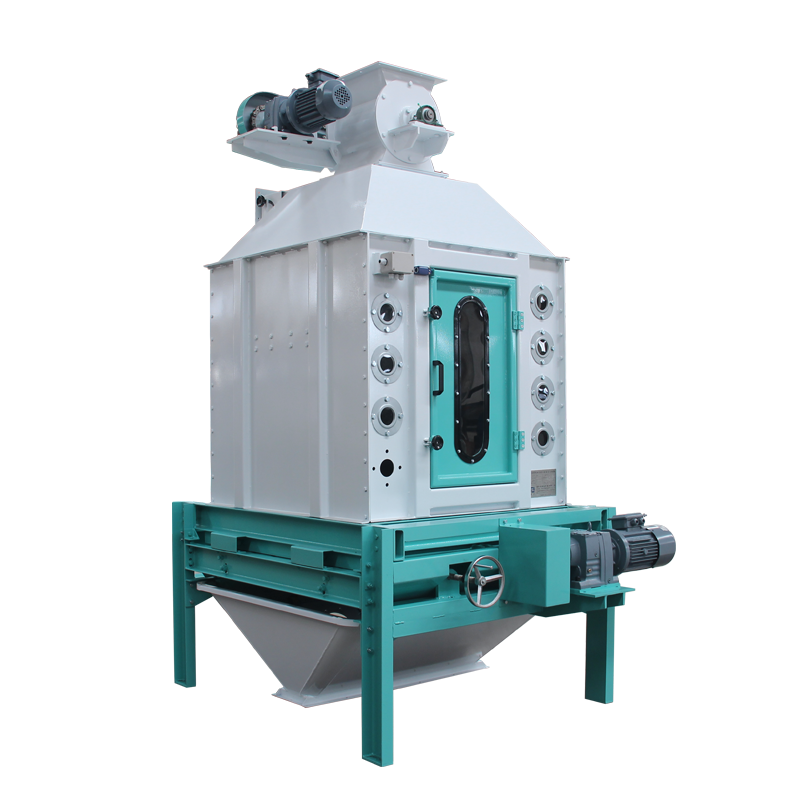
How Does a Counterflow Cooler Work in a Feed Pellet Production Line?
In a complete feed pellet production line, cooling is an essential process after pelletizing. Fresh pellets discharged from the pellet mill usually have high temperature and moisture content, which can affect pellet hardness, storage stability, and feed quality. A high-efficiency counterflow cooler is designed to quickly reduce pellet temperature and moisture through advanced airflow technology, making it one of the most important pieces of feed cooling equipment in modern feed mills.
What Is a Counterflow Cooler?
A counterflow cooler is a vertical cooling machine that uses the principle of reverse airflow. During operation, hot feed pellets enter the upper part of the cooling chamber, while cool air enters from the bottom and moves upward. The airflow direction is opposite to the pellet movement direction, which creates efficient heat and moisture exchange.
Compared with traditional cooling methods, the counterflow pellet cooler provides more uniform cooling performance because the coldest air contacts the pellets that are already close to the discharge stage, while warmer air absorbs heat from newly produced pellets at the top. This design improves cooling efficiency and helps reduce pellet cracking and powder generation.
Working Principle of Pellet Cooler in Feed Production
1. Hot Pellet Feeding
After the pelletizing process, high-temperature pellets enter the cooling chamber through the feeding device and are evenly distributed inside the cooler.
2. Reverse Airflow Cooling
The fan draws fresh air through the cooling chamber. The air passes upward through the pellet layer, removing heat and moisture from the pellets.
3. Temperature and Moisture Reduction
The continuous heat exchange process reduces pellet temperature close to ambient conditions and lowers moisture to a suitable level for storage and transportation.
4. Automatic Discharge
The cooled pellets are discharged through the outlet system. The discharge speed can be adjusted according to production capacity and pellet characteristics.
Yuda Counterflow Cooler Technology
Yuda Machinery’s pellet cooling machine adopts advanced airflow distribution and material level control technology to achieve stable cooling performance. The SKLN series counter flow cooler covers different production capacities, including models suitable for small feed mills and large-scale feed production plants.
For example, SKLN1.5 is suitable for approximately 1–2.5 T/H production capacity, while larger models can reach higher capacities up to 35 T/H, meeting the cooling requirements of different feed pellet production lines.
Advantages of Counterflow Pellet Cooler
A reliable pellet cooler system provides several advantages for feed manufacturers:
1. Improved Pellet Quality
Uniform cooling helps maintain pellet hardness and reduces the generation of fines. By controlling temperature and moisture content, the counterflow pellet cooler helps produce stronger and more stable feed pellets.
2. Energy-Efficient Operation
The optimized airflow design improves heat exchange efficiency and reduces unnecessary energy consumption. Compared with traditional cooling equipment, the counterflow cooler achieves better cooling performance with lower fan power requirements.
3. Stable Moisture Control
Proper cooling effectively removes excess moisture from pellets, preventing mold growth and improving storage performance. This is especially important for large-scale feed mills that require long-term pellet storage.
4. Flexible Application
The pellet coolers can be used for different types of feed production, including poultry feed, livestock feed, aquatic feed, and other pellet processing applications. Different models and configurations can be selected according to production capacity and pellet characteristics.
Applications of Pellet Coolers in Feed Mills
Modern pellet coolers are widely used in poultry feed plants, livestock feed factories, and complete feed processing projects. After the pelletizing process, the cooling system plays an important role in ensuring final product quality.
Whether for a small-scale pellet mill or a large industrial feed production line, selecting the right counterflow cooler can improve production efficiency, reduce pellet damage, and ensure consistent feed quality.
With the increasing demand for energy saving, automation, and high-quality feed production, the counterflow cooler has become an essential cooling solution for modern feed pellet production lines.
Yuda Machinery provides efficient counterflow pellet cooler solutions with reliable performance, flexible configurations, and stable operation to meet the requirements of global feed manufacturers.
Frequently Asked Questions About Counterflow Cooler
1. What is a counterflow cooler used for in a feed pellet production line?
A counterflow cooler is used to reduce the temperature and moisture content of hot feed pellets after the pelletizing process. It uses reverse airflow technology to improve cooling efficiency, maintain pellet quality, and prepare pellets for screening, packaging, and storage.
2. How does a counterflow pellet cooler work?
A counterflow pellet cooler works by allowing hot pellets to move downward while cool air flows upward through the pellet layer. The opposite movement between pellets and airflow creates efficient heat and moisture exchange, resulting in uniform cooling performance.
3. Why is a counterflow cooler better than traditional pellet coolers?
Compared with traditional pellet coolers, the counterflow cooler provides better airflow utilization, higher cooling efficiency, and lower energy consumption. It also helps reduce pellet breakage and improves final feed pellet durability.
4. What types of feed can be cooled by a pellet cooling machine?
A pellet cooling machine is widely used for cooling different types of feed pellets, including poultry feed, livestock feed, aquatic feed, and other biomass or agricultural pellet products.
5. How do I choose the right counterflow cooler for my feed mill?
The selection of a suitable counter flow cooler depends on several factors, including production capacity, pellet diameter, feed type, moisture content, cooling time requirements, and available installation space.
For example, small feed mills may choose compact models, while large feed production lines usually require high-capacity cooling systems.
6. What is the production capacity of Yuda counterflow cooler?
Yuda Machinery provides different models of counterflow coolers to meet various feed production requirements. The SKLN series covers different capacities, from small feed mills to large industrial feed plants. Some models can achieve cooling capacities up to approximately 35 T/H depending on pellet type and production conditions.
7. How can a counterflow cooler improve pellet quality?
A counterflow cooler removes heat and moisture evenly, helping prevent pellet deformation, cracking, and mold problems. Proper cooling improves pellet hardness, durability, and storage stability.
Written by: Yuda Machinery Engineering Team
Based on years of experience in feed machinery manufacturing, equipment design and overseas project installation.
Table of Contents
- 1. Hot Pellet Feeding
- 2. Reverse Airflow Cooling
- 3. Temperature and Moisture Reduction
- 4. Automatic Discharge
- 1. What is a counterflow cooler used for in a feed pellet production line?
- 2. How does a counterflow pellet cooler work?
- 3. Why is a counterflow cooler better than traditional pellet coolers?
- 4. What types of feed can be cooled by a pellet cooling machine?
- 5. How do I choose the right counterflow cooler for my feed mill?
- 6. What is the production capacity of Yuda counterflow cooler?
- 7. How can a counterflow cooler improve pellet quality?
