
 EN
EN


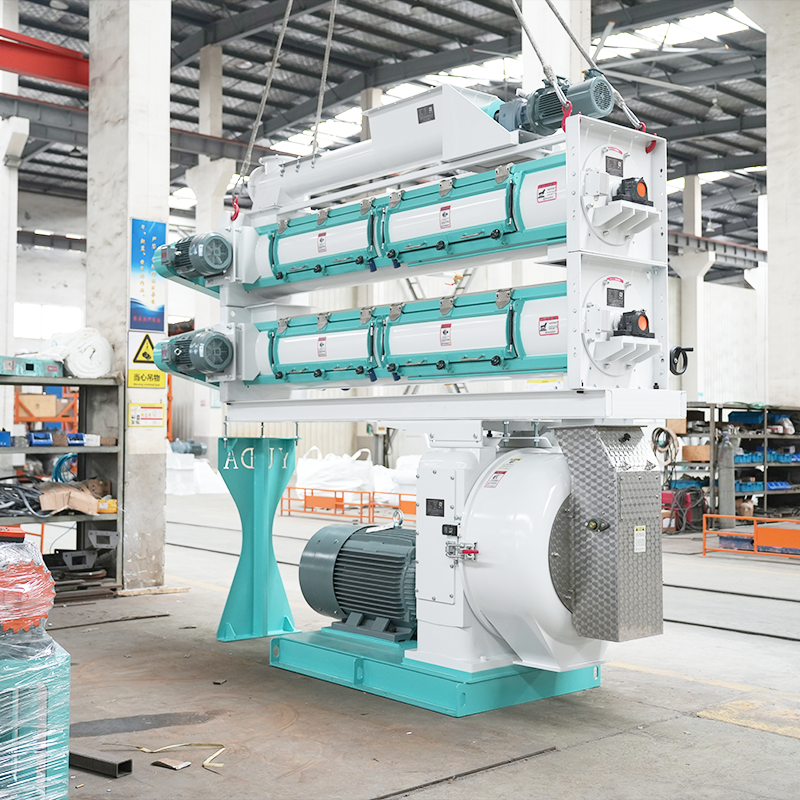
Animal feed pellet machines must operate optimally to reduce costs of production and to guarantee the continuity of output. Even the best equipment will not perform optimally unless key operational factors are properly maintained. Shanghai Yuanyuda International Trade Co., Ltd. has presented the following 5 tips which may be employed to ensure maximization of the performance of your feed pellet mill.
Tip 1: Optimize Raw Material Preparation Before Pelleting
A successful pelletizing process begins with the well prepared raw materials. Particle size and the quantity of moisture directly affect the bonding of the material in the pellet chamber. Preferably, aiming at the optimum results, your ground matter ought to consist of 12-18 percent of moisture. Excessively dry material will not be able to create stable pellets, and excessively wet material may clog the ring die. Additionally, a homogenous particle size may be attained with the help of a good hammer mill or vertical pulverizer. The accurate and smooth grinding allows the flow of the feed across the holes in the die easily, which improves throughput and reduces the wasteful roller shell and ring die wear.
Tip 2: Perform Regular Maintenance on Critical Components
A well-maintained machine is an efficient machine. The center of your pellet mill is the ring die and roller shells. These parts wear out over time and fail to compress the material efficiently. Frequent inspection of the ring die surface is needed to determine whether it is polished or clogged. Performance is significantly impaired when the die becomes glazed. Similarly, ensure that there are no grooves or flats within roller shells. Shanghai Yuanyuda International Trade Co., Ltd. recommends keeping a stock of spare parts including screen plates, hammer mill blades, clamps and spindle assemblies. Preventive repairs ensure that those components which are poor are substituted prior to their failure to operate and guarantee consistent quality of the pellets.
Tip 3: Adjust Roller and Die Clearance Precisely
The distance between the roller shell and the ring die is one of the most crucial adjustments on any feed pellet machine. In the event that the clearance is too large, the rollers will not be in a position to press material through the die holes in the most effective manner leading to low output and massive fines. The metal-to-metal contact can be made with too small a clearance and will wear away at very high rates, so damaging hollow shaft and clamp mechanisms. In the majority of animal feed applications, the gap has to be between 0.2 and 0.5 millimeters. Check the clearance with a feeler gauge afterwards with a feeler gauge, especially when changing rollers or dies. The best adaptation would be to ensure that every rotation of the die is as effective as possible in the number of pellets produced as well as the amount of energy consumed.
Tip 4: Control Feed Flow and Conditioning Time
The machine is not as important as the flow of material to the pellet mill. The lumpy feeding will cause the motor when straining during certain periods and the motor will run lightly during different periods, which will prove to be less efficient. Use a screw conveyor or chain conveyor to provide a smooth, continuous flow of conditioned mash. Also Record the conditioning time and quality of steam. The feed is made pliable by proper conditioning which makes it wet and hot. This reduces the amperage drawn by the main motor a lot less and raises the die life.
Tip 5: Match Pellet Size to Production Requirements
The appropriate ring die specifications in relation to your desired pellet size enhance speed and quality. Smaller die holes produce denser pellets but reduce throughput. as the hole in the die is smaller. The larger size allows more production to be done but may not be suitable for young animals or special feeds. One such example is that aquatic feed typically requires smaller, more stable pellets in comparison to livestock feed which can be resistant to larger sizes. The trick to this is to ensure a ring die that can suit your volume production needs and end-use needs of your animals is always chosen. Shanghai Yuanyuda International Trade Co., Ltd. is a company which offers a customization of dies used in both local and foreign models, whereby you may perfectly adapt the hole size, the thickness of dies and their compression ratio to your formula.
With these five tips, you will be able to greatly enhance the effectiveness of your animal feed pellet machine and the service life of some of the most important components, such as the ring die, roller shell, and spindle. Output improvement and low operating expenses are achieved with small adjustments in the preparation of raw materials, maintenance schedule, clearance parameters, feed rates and die selection.