
 EN
EN


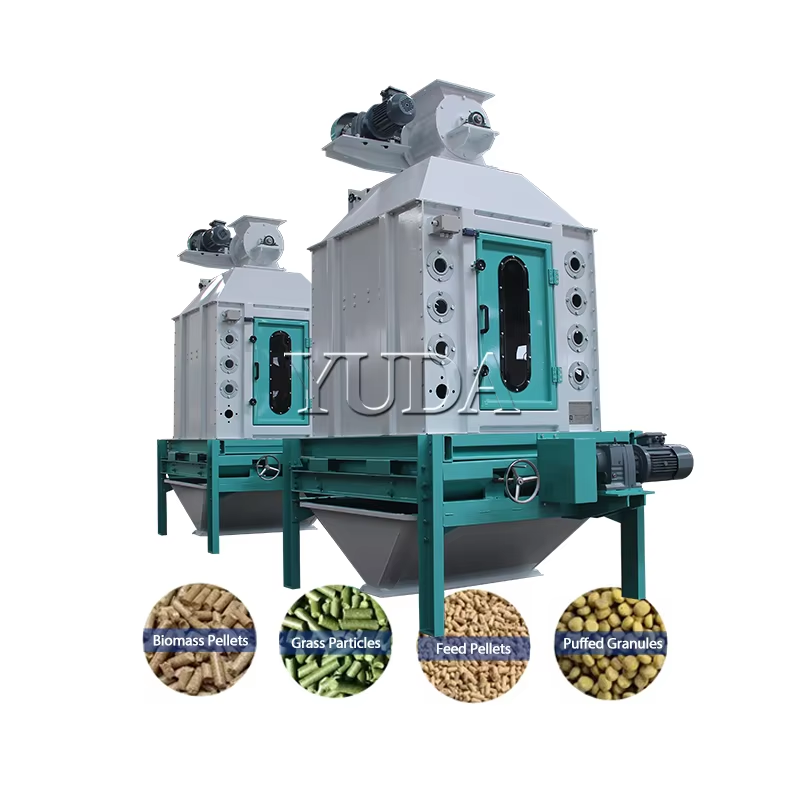
Advanced cooling technology is needed in the production of high quality, durable and safe animal feed. A key component in this process is counterflow pellet coolers, which utilize an advanced process where the cool air flows through a moving bed of hot pellets. This achieves effective heat and moisture removal. In cases where feed mills are modernizing their equipment (i.e., granulating, drying, and conveying equipment), the addition of a counterflow cooler can actually improve the overall performance of the production line the overall performance of the production line. There are four major applications of these coolers as illustrated below.
Guaranteeing Strength and Durability of Pellets
Pellets that come out of the pellet mill/ extruder are soft, hot, and pliable. Fast or disproportionate cooling may result in cracking and superfine particles. Counterflow cooling process ensures that the temperature decreases slowly avoiding thermal shock. By doing so, it evenly removes heat and moisture, which facilitates the proper hardening of the pellets and directly enhances the Pellet Durability Index (PDI). Consequently, pellets are more resilient to fracturing during conveying, mixing, and packaging, and maintain nutritional content and limit waste.
Maximizing Moisture Control in Safety and Shelf Life
It is highly important to control the moisture. Too much moisture promotes the growth of mold and the degradation of nutrients. Counterflow coolers are effective in ensuring that the moisture content in the pellets is kept to safe, steady levels that are normally slightly lower than the ambient air humidity, thus preventing condensation on the cooled pellets in storage bins. This is critical particularly in feed mills whose dryer equipment is at earlier stages, because it finishes the stabilization process. Adequate moisture control directly prolongs the shelf life of animal feed and ensures its safety.
Pelletizing: Preparation of Pellets to be used in coating and adding fats
a lot of feed mixtures need to be coated with fat, enzymes, or other liquid supplements to increase their nutritional content. When these coatings are applied to hot pellets, absorption is poor and the risk of rancidity is higher. Counterflow coolers bring pellets to uniform and optimum temperature and surface condition, thereby being ready to be further coated by mixing equipment. This guarantees increased absorption and retention of liquid additives resulting in even distribution of nutrients and reduced wastage. The cooler is an important preparation stage in value-added feed processing.
Increasing Total Mill Efficiency and Recovery of Energy
Contemporary counterflow coolers help increase the productivity of feed mill. The heat exchange countercurrent principle enhances energy conservation. More sophisticated designs have the ability to reuse warm exhaust air to preheat air for the plant’s dryer equipment, resulting in less overall energy usage. Also, these coolers produce uniformly cooled, stable pellets, which reduce wear on downstream conveying and sorting systems, reduce downtime, and enhance material flow.
To conclude, counterflow pellet coolers are not just a cooling device but an integral part of process optimization and quality assurance in contemporary feed mills. their applications directly impact product quality and profitability by ensuring pellets are strong, safe, easy to coat, and energy-efficient to produce. A high-performance cooler is an investment that should be made to accompany the trusted granulating and extruder equipment, w