
 EN
EN


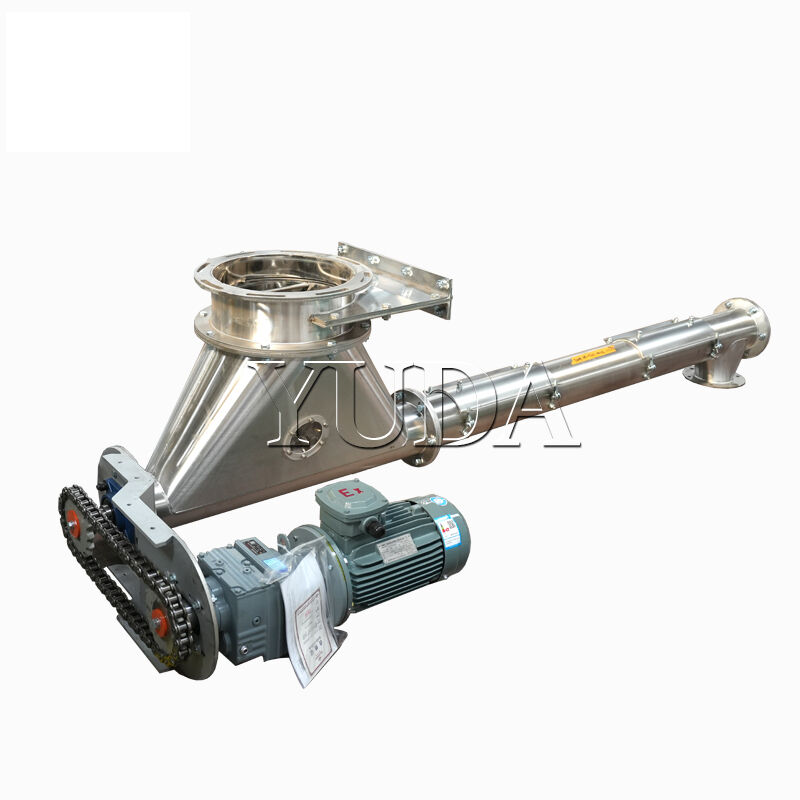
The selection of a conveying system is highly significant to the industrial processes because efficiency, product integrity, and cost-effectiveness are directly influenced by the choice of conveying system. We (Shanghai Yuanyuda International Trade Co. Ltd.) focus on the provision of robust conveying equipment, and also a complete assortment of supporting machinery including granulating, mixing, and grinding equipment. The screw conveyor and the belt conveyor are two of the most widely used workhorses in material handling. Learning of their basic distinctions will assist you in selecting which system is most suitable to meet your material handling requirements.
Principle of Working and Design
The fundamental difference lies in how material is transported in each system. A screw conveyor (also known as auger conveyor) is a system of moving bulk material using a helical shaped blade in a tube/ trough and is turned by a motor. It is a small and closed system that is suitable for controlled, volumetric transfer. Conversely, a belt conveyor is used to transfer material on a belt that is The decision is not only about selecting a conveyor but also about choosing the right supporting components. This is an open system which is of high-throughput and long-distance transport. Not only about picking a conveyor, but it’s about picking the right supporting elements, be it durable roller shells and spindles in the case of belt systems, or high precision hollow shafts and screw elements in the case of augers, which are supported by our knowledge of engineering.
Handling and Compatibility with Material
Material properties are crucial. Screw conveyors are best with dry to semi-dry powders, granules, flakes and small lumps (e.g. feed, meal, wood chips). They are convenient to use in the process of metering, mixing, or to transfer materials between enclosed processes or between the dryer equipment and sifting stations since their closed design will reduce dust and contamination. They can however not accommodate fine, very abrasive or sticky materials which may damage or obstruct them.
Belt conveyors, however, have higher flexibility. They are able to process particles as finely as fine powders and as delicate as pellets (like the products of crumble equipment) as well as coarse and rough aggregates. They are used in packaged products, grains, and non-fluid bulk products that require the maintenance of particle structure. In case of abrasive materials, the system can be used, but equipment service life can be extended by equipping the system with our hammer mill blades or ring dies, which will minimize the particle size first.
Layout Flexibility and Configuration
Take into consideration your process flow and plant layout. Screw conveyors have great spatial flexibility. They may be placed at the same level or in a down slope, or even in an upward direction. They can be fed by extruder equipment or cooling systems because of their design having multiple inlet and discharge points. With modular construction, it is easy to customize it.
Belt conveyors are popular with long, horizontal, high volume, and low-gradient transportation. They are best suited to translocation of materials in a large facility, for example, from receiving areas to cleaning and mixing equipment lines. They are not as flexible as tight and multi-directional designs, but as far as conveying capacity on a long distance, they are unmatched.
Cost and Maintenance Factors
Screw conveyors are cost-effective to manufacture and relatively easy to operate. Maintenance is usually in the form of inspection of screw flight wear, bearings and drive parts. They are sealed, keeping materials out of the environment, but may complicate the internal inspection and cleaning.
Belt conveyors could be costlier to install initially, but could be more cost effective in longer distance applications. Maintenance is concerned with belt tracking, tension, roller condition and cleaning. They are open in structure and hence easier to observe and clean. We have tested spare parts including screen plates, clamps and tailor-made components, both domestic and international models at Shanghai Yuanyuda, so that your production line will be running well.