
 EN
EN


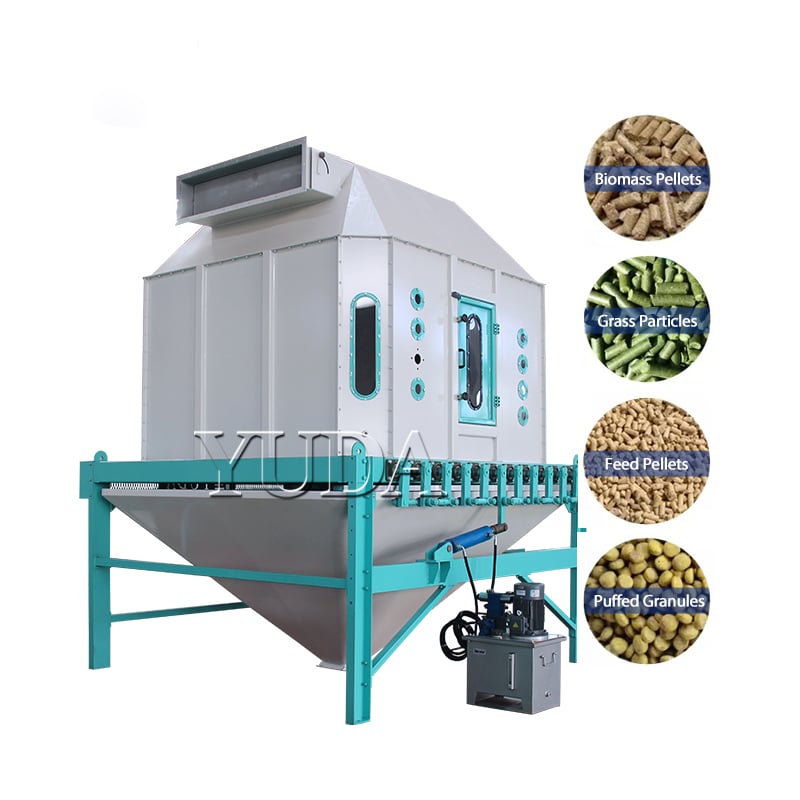
Post hot extrusion and pelletization, the feed pellets exit at high temperatures of over 80 °C and at an unacceptably high moisture level for storage. Premature or uneven cooling may lead to surface cracks, internal stresses, and spoilage in storage. A counterflow cooler has become an industry standard for resolving these issues. Its principle is simple: draw ambient air upwards through a deep bed of moving pellets moving downwards, so both the pellets and air cool down slowly, steadily and evenly. Shanghai Yuanyuda International Trade Co., Ltd. understands that stable pellets are the prerequisite for quality feed and cooling is the key to pellet durability.
The Principle of Counterflow Air Movement for Even Drying
The most distinctive characteristic of a counterflow cooler is its use of an air flow direction which is opposite to that of the pellet flow. The hot pellets come in from the top and descend slowly through the cooling tower as the fan pulls cold ambient air upwards through the column of hot pellets. This ensures cool air contacts the coolest pellets at the bottom discharge side, while the hottest air gathers at the top of the pellet column where hot pellets first enter the cooling section.
This way, thermal shock to pellets is avoided because pellet cores and pellet surfaces are cooled almost simultaneously.
Shanghai Yuanyuda International Trade Co., Ltd. implements this principle in its SKLN series counterflow coolers with specially designed rotary discharge and a fan to provide optimized and even cooling air in the pellet column. An evenly cooled pellet has a uniformly low moisture throughout.
Controlling Cooling Time and Airflow for Optimal Moisture Removal
To make pellets stable and durable, Two key variables require precise balancing: pellet retention time (how long pellets remain in the cooler) and airflow volume.
If pellets pass through the cooler too rapidly, they may appear dry on the outside but are still hot and moist in the inside. They will continue to be moist until they slowly redistribute moisture to the outside, causing expansion and cracks. Excessive airflow will over-dry pellet outer layers, making them overly dry and brittle.
Ideally, pellet retention time should be maintained between six and ten minutes, depending on pellet diameter and composition, and ensure moderate air flow to take the surface moisture away while keeping the interior moist and strong.
Shanghai Yuanyuda International Trade Co., Ltd. advises the use of the variable- speed discharge rotor to regulate this retention time to match your feed pellet mill capacity and product characteristics.
Preventing Condensation and Surface Cracking
It is common to have condensation problems inside the cooler or downstream equipment such as storage bins. Warm humid air may condense on the cooler’s cold metal surfaces and then be reabsorbed by pellets, making pellets adhere to the discharge screen, trigger microbial growth and lower pellet hardness. Proper cooling air design avoids this problem by keeping the air intake temperature just above the dew point and using proper insulation if required. Besides, the deep-bed design also functions as a natural filter to trap fine particles and dust, which may become a fire hazard.
Shanghai Yuanyuda International Trade Co., Ltd. equips its SKLN counterflow coolers with an easily removable discharge screen, large access doors for internal cleaning, and a dust collector to protect the workshop environment.
Impact on Pellet Durability and Feed Mill Efficiency
The end-product stability brought by a stable cooling process contributes a lot to other aspects of feed mill operations. Pellets that are cooled to near ambient temperature and about 10-12% moisture are harder, produce less fines during pneumatic transportation or handling at the farm, and can better withstand compression during bagging or shipment.
This will greatly reduce product return rate and improve the reputation of the feed manufacturer. Reduced fines means less load on downstream sifters and dust collectors, hence less energy consumption and lower maintenance costs. It also allows the feed mill to operate the pellet mill at maximum capacity as stable cooling eliminates production bottlenecks. Shanghai Yuanyuda International Trade Co., Ltd. supplies SKLN counterflow coolers in a wide range of capacities to match various feed mill production scales and our experts can provide onsite consultation and training to set optimal cooling parameters for your unique formula.
In summary, the counterflow cooler stabilizes feed pellets through optimized:four core measures: countercurrent air-pellet flow, precise retention time control, condensation prevention and pellet durability guarantee. It serves not just as the finishing machine for a pelleting line, but actively safeguards product quality and enhances operational efficiency. For further inquiries regarding cooler model selection and sizing, airflow adjustment, or maintenance schedule, please consult our engineers at Shanghai Yuanyuda International Trade Co., Ltd.
