
 EN


Introduction
Mixing uniformity is one of the most important factors affecting the consistency and quality of animal feed. In a commercial feed mill, ingredients such as corn, soybean meal, wheat bran, minerals, vitamins, amino acids, and other additives must be distributed evenly throughout the feed formula.
Poor mixing uniformity can lead to inconsistent nutrient distribution. Some portions of a feed batch may contain more additives than required, while others may contain less. This can affect feed formulation accuracy, product consistency, and the overall reliability of feed production.
However, improving feed mixing uniformity does not simply mean extending the mixing time. Ingredient characteristics, particle size, batching accuracy, loading sequence, mixer structure, liquid addition, and equipment maintenance all influence the final mixing result.
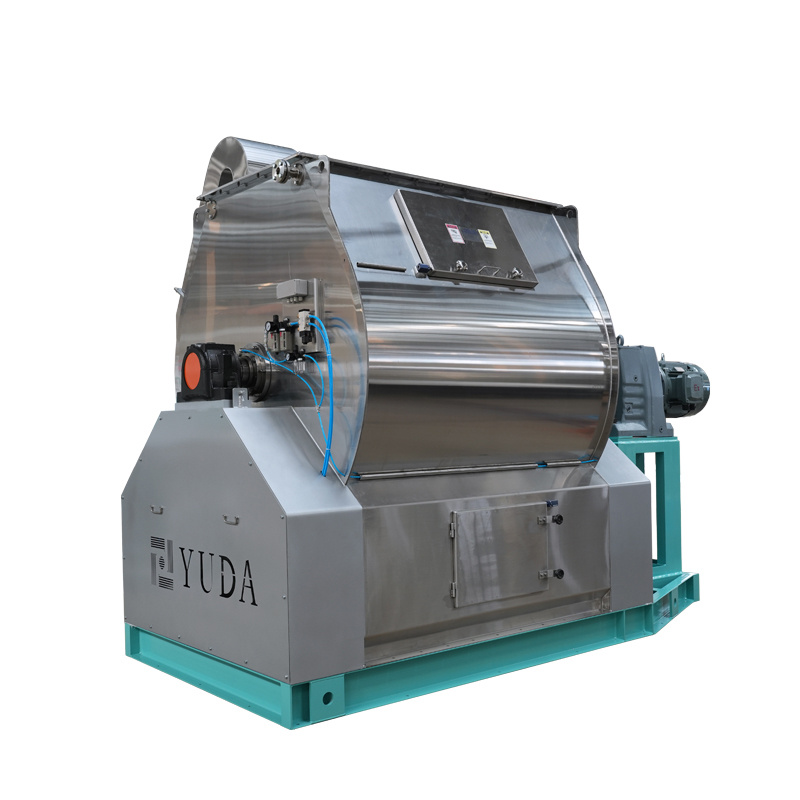
This article explains how to improve mixing uniformity in animal feed production by optimizing ingredient preparation, batching accuracy, mixing time, liquid addition, and equipment operation. It also introduces the YUDA SDHJ Series Single-Shaft Paddle Mixer, focusing on its mixing structure, technical features, and applications in animal feed and premix production.
1. What Is Mixing Uniformity in Animal Feed Production?
Mixing uniformity refers to how evenly different ingredients are distributed throughout a batch of animal feed. A well-mixed feed batch should contain a consistent proportion of major ingredients and micro-ingredients in samples collected from different locations.
In animal feed production, ingredients usually have different physical properties:
Major ingredients: corn, wheat, soybean meal, and other bulk materials.
Protein ingredients: soybean meal, fish meal, and other protein sources.
Mineral ingredients: calcium carbonate, phosphate, and salt.
Micro-ingredients: vitamins, trace minerals, amino acids, and premix additives.
Liquid ingredients: oils, fats, and other formulation-specific liquids.
The challenge is that these ingredients may differ in particle size, bulk density, flowability, and addition ratio. If they are not properly prepared and mixed, some components may remain concentrated in certain areas instead of being evenly distributed.
For this reason, feed mixing uniformity should be evaluated through representative sampling and appropriate testing rather than visual inspection alone.
How Is Feed Mixing Uniformity Measured?
One commonly used evaluation method is the coefficient of variation (CV). It measures how much the test results vary around their average value.
\[ CV=\frac{\text{Standard Deviation}}{\text{Mean}}\times100\% \]
A lower CV generally indicates more consistent distribution of the tested ingredient across the sampled batch.
For reliable testing, manufacturers should:
Select a suitable tracer or indicator ingredient.
Collect samples from representative positions or batches.
Use the same sampling and laboratory method for comparison.
Compare the results with the required product or process specification.
The CV result depends on the sampling plan, tracer, test method, and operating conditions. Therefore, a CV value should always be interpreted together with its test procedure.
2. What Factors Affect Animal Feed Mixing Uniformity?
Feed mixing performance is influenced by several factors throughout the production process. Even a well-designed feed mixer may not achieve the expected result if the ingredients are poorly prepared or the batching process is inaccurate.
The following factors deserve particular attention.
1) Particle Size Differences
Ingredients with significantly different particle sizes may separate during mixing, conveying, or discharge. Fine powders and coarse particles can move differently inside the mixing chamber.
Improvement: Use a suitable grinding process to control particle size and reduce unnecessary differences between ingredients. Avoid introducing excessive quantities of oversized particles or agglomerates into the mixer.
2) Bulk Density and Flowability
Materials with different bulk densities and flow characteristics may distribute unevenly. Lightweight materials can behave differently from dense mineral ingredients, especially when the formulation contains small quantities of additives.
Improvement: Understand the physical properties of each ingredient before selecting the mixer. Pay attention to material flow, feeding stability, and the distribution of low-inclusion ingredients.
3) Batching Accuracy
Incorrect weighing or unstable feeding can create ingredient-ratio deviations before mixing even begins. A mixer cannot fully correct an inaccurate formulation.
Improvement: Calibrate weighing equipment regularly, verify ingredient setpoints, and check whether the batching system delivers the required quantity consistently.
4) Loading Sequence and Mixing Time
The order in which ingredients enter the mixer can influence how they are distributed. Mixing for too short a period may leave ingredients unevenly dispersed, while unnecessarily long mixing may reduce production efficiency and, depending on the material and mixer, may contribute to segregation.
Improvement: Establish a repeatable loading sequence and determine the appropriate mixing time through trials using the actual formula and operating conditions.
5) Liquid Addition
Oil, fat, and other liquids can change the flow and adhesion characteristics of feed materials. Poorly controlled liquid addition may cause local wet spots, agglomeration, or uneven distribution.
Improvement: Select a suitable liquid addition arrangement and control the addition rate and spraying distribution. Confirm the compatible liquid-addition configuration with the mixer manufacturer.
3. Practical Ways to Improve Mixing Uniformity
Improving mixing uniformity requires coordinated optimization of ingredient preparation, batching, mixer operation, and quality inspection. The following measures can help feed manufacturers identify process problems and improve batch consistency.
|
Improvement area |
Recommended action |
Expected benefit |
|
Ingredient preparation |
Control particle size and remove agglomerates |
More consistent material movement |
|
Batching |
Calibrate scales and verify ingredient ratios |
More accurate formulation |
|
Loading |
Use a repeatable ingredient sequence |
More stable mixing conditions |
|
Mixing time |
Validate the cycle with actual feed formulas |
Balance uniformity and throughput |
|
Liquid addition |
Check spray distribution and addition rate |
Reduce local wet spots and clumping |
|
Equipment condition |
Inspect paddles, seals, and discharge parts |
Maintain stable operation |
|
Quality testing |
Use representative samples and CV analysis |
Verify actual mixing performance |
3.1 Standardize Ingredient Preparation
Ingredients should be prepared according to their physical characteristics before entering the mixer. Grinding, screening, and removal of agglomerates can help create more consistent feeding conditions.
3.2 Improve Batching Accuracy
The mixing process starts with accurate ingredient measurement. A stable batching system helps ensure that the actual ingredient proportions match the feed formula.
3.3 Optimize the Mixing Cycle
Do not assume that a longer mixing time always produces better uniformity. Test different mixing cycles with the actual formula and compare the CV results. The selected cycle should meet the quality requirement while maintaining production efficiency.
3.4 Control Liquid Addition
When oil or other liquids are included, the spraying position, distribution, and addition rate should be checked. The mixer should be configured for the type and amount of liquid used in the formula.
3.5 Maintain the Mixer and Discharge System
Worn or damaged mixing components, accumulated material, and incomplete discharge can affect subsequent batches. Regular inspection and cleaning help maintain consistent mixing conditions and reduce carryover between formulas.
4. How Does the SDHJ Single-Shaft Paddle Mixer Improve Feed Mixing Uniformity?
In addition to process control, the structure of the mixer itself plays an important role in material movement and ingredient distribution.
Different mixer designs create different mixing patterns. YUDA provides several horizontal feed mixing solutions, including single-shaft paddle mixers, double-shaft paddle mixers, and ribbon mixers.
4.1 SDHJ Series Single-Shaft Paddle Mixer
The YUDA SDHJ single-shaft paddle mixer is designed for mixing free-flowing powdered materials in compound feed factories. It is particularly suitable for premix production.
Its documented design features include:
Double-layer paddle structure for mixing performance.
Main paddle-to-cylinder clearance of no more than 3 mm.
Full-length large-opening discharge structure for fast unloading and low residue.
Large-section return air pipes to balance pressure between the upper and lower chambers.
Combined shaft-end air sealing structure.
Multi-channel liquid addition pipelines, with a stated liquid addition capacity of up to 5%.
Compressed-air blowing cleaning system to help prevent cross-contamination.
The SDHJ product page lists a mixing time of 45–60 seconds, mixing uniformity of CV≤5%, and a residue rate of ≤0.1%. These are published SDHJ product-page figures; actual performance should be confirmed against the specific formula, test method, and operating conditions.
5. YUDA Feed Mixer Technical Specifications
YUDA's product catalog lists three main mixer series: SDHJ single-shaft paddle mixers, and their batch capacities and power configurations are different.
SDHJ Series Single-Shaft Paddle Mixer
|
Model |
Effective volume (m³) |
Power (kW) |
Capacity (kg/batch) |
|
SDHJ0.2 |
0.2 |
3/4 |
100 |
|
SDHJ0.5 |
0.5 |
5.5/7.5 |
250 |
|
SDHJ1 |
1 |
11/15 |
500 |
|
SDHJ2 |
2 |
18.5/22 |
1,000 |
|
SDHJ3 |
3 |
22/30 |
1,500 |
|
SDHJ4 |
4 |
30/37 |
2,000 |
|
SDHJ6 |
6 |
45/55 |
3,000 |
|
SDHJ8 |
8 |
75/90 |
4,000 |
Note: The tables show selected published catalog configurations. Confirm the final model, motor option, and configuration with YUDA before placing an order.
6.When selecting a YUDA SDHJ single-shaft paddle mixer, feed manufacturers should consider the following factors:
Batch capacity: Determine the required batch weight according to the production schedule and downstream processing capacity.
Material characteristics: Evaluate particle size, bulk density, flowability, and moisture content.
Liquid addition: Confirm whether the formula contains oil or other liquids and whether the required addition ratio is within the equipment configuration.
Mixing uniformity: Define the required CV target and testing method.
Cleaning requirements: Consider formula change frequency, residue control, and cross-contamination prevention.
Installation conditions: Check available space, power supply, and connections to upstream and downstream equipment.
Ingredient names and physical characteristics.
Target batch weight and required production output.
Particle size and bulk density of the main ingredients.
Whether the formula includes oil, fat, or other liquids.
Required mixing uniformity and the test method used to verify it.
Formula change frequency and cleaning requirements.
Available installation space and downstream equipment capacity.
A mixer should be tested or technically evaluated with the actual feed formula whenever possible. This is especially important for premixes and formulas containing low-inclusion ingredients.
7. Common Mixing Problems and Troubleshooting
When mixing uniformity declines, the first step should be to identify whether the problem comes from ingredient preparation, batching, mixer operation, or equipment condition.
|
Problem |
Possible cause |
Recommended inspection |
|
Uneven ingredient distribution |
Particle size or density differences |
Review grinding, screening, and ingredient properties |
|
Different CV results between batches |
Unstable batching or inconsistent loading |
Check weighing accuracy and loading sequence |
|
Local wet spots or agglomerates |
Poor liquid distribution |
Inspect liquid pipelines, spray points, and addition rate |
|
Excessive material residue |
Incomplete discharge or material build-up |
Check discharge door and internal cleaning |
|
Dust escaping during operation |
Pressure imbalance or restricted return air |
Inspect return air pipes and sealing |
|
Mixing performance changes over time |
Worn or incorrectly adjusted components |
Inspect paddles, rotor clearance, seals, and drive system |
These are general process inspection priorities, not confirmed diagnoses for every mixer model. Always follow the machine-specific operating manual and isolate the power supply before maintenance.
8. How to Verify Mixing Uniformity in Daily Production
A stable feed mixing process should be supported by regular quality checks. Rather than relying on one test result, manufacturers should establish a repeatable verification procedure.
A practical quality-control routine can include:
After commissioning: Test the mixer with the intended formula and confirm the agreed mixing time and uniformity target.
After formula changes: Recheck the mixing result when ingredient proportions or physical properties change significantly.
During routine production: Collect representative samples at defined intervals and compare the results.
After maintenance: Verify mixing performance again if paddles, seals, discharge components, or other critical parts have been adjusted or replaced.
When results fluctuate: Review batching records, loading conditions, liquid addition, and equipment status before changing the mixing cycle.
For premix and micro-ingredient applications, sampling and testing should be designed carefully because small ingredient proportions can make the results particularly sensitive to sampling errors.
9. Why Choose YUDA SDHJ Single-Shaft Paddle Mixer?
The YUDA SDHJ Series Single-Shaft Paddle Mixer is designed for powdered material mixing in compound feed production, particularly premix applications. Its double-layer paddle structure, small paddle-to-cylinder clearance, full-length discharge design, and multiple liquid addition pipelines support different feed mixing requirements.
With published specifications including CV≤5% mixing uniformity, 45–60 seconds mixing time, and a residue rate of ≤0.1%, the SDHJ series provides a solution for feed manufacturers seeking consistent batch mixing performance.
YUDA can evaluate the required batch capacity, ingredient characteristics, liquid addition ratio, and production-line layout to recommend a suitable SDHJ model.
10. Frequently Asked Questions
Q1: What is the most important factor affecting animal feed mixing uniformity?
A: There is no single factor that determines mixing uniformity. Ingredient particle size, bulk density, batching accuracy, loading sequence, mixing time, liquid addition, and mixer design all influence the final result.
Q2: Does a longer mixing time always improve feed mixing uniformity?
A: No. Mixing time should be determined through testing with the actual feed formula. Excessive mixing may reduce production efficiency and, under some material and equipment conditions, may contribute to segregation.
Q3: What is the published mixing uniformity of the YUDA SDHJ mixer?
A: The SDHJ product page lists a mixing uniformity of CV≤5%, a mixing time of 45–60 seconds, and a residue rate of ≤0.1%. These figures should be verified for the actual formula and test conditions.
Q4: Is the SDHJ single-shaft paddle mixer suitable for premix production?
A: The YUDA SDHJ single-shaft paddle mixer is specifically described as suitable for free-flowing powdered materials and premix production. The final choice should also consider batch size, ingredient characteristics, liquid addition, and cleaning requirements.
Q5:Can the SDHJ mixer add oil or other liquids?
A: Yes. YUDA's SDHJ product documentation describes liquid or oil addition arrangements. The stated maximum liquid addition capacities differ by model series, so confirm the required liquid type, proportion, and configuration before ordering.
Q6: How can feed manufacturers check mixing uniformity?
A: Manufacturers can use representative sampling and a suitable tracer test to calculate the coefficient of variation (CV). The sampling method and test procedure should remain consistent when comparing different batches.
Conclusion
Improving mixing uniformity in animal feed production requires more than increasing mixing time or selecting a larger machine. Ingredient preparation, batching accuracy, loading sequence, liquid addition, equipment design, and routine quality testing must work together.
By understanding these factors and selecting a mixer that matches the actual production requirements, feed manufacturers can build a more stable mixing process and improve product consistency.
YUDA provides SDHJ single-shaft paddle mixers for different material characteristics and feed production processes.
Written by: YUDA Machinery Engineering Team
