
 EN
EN


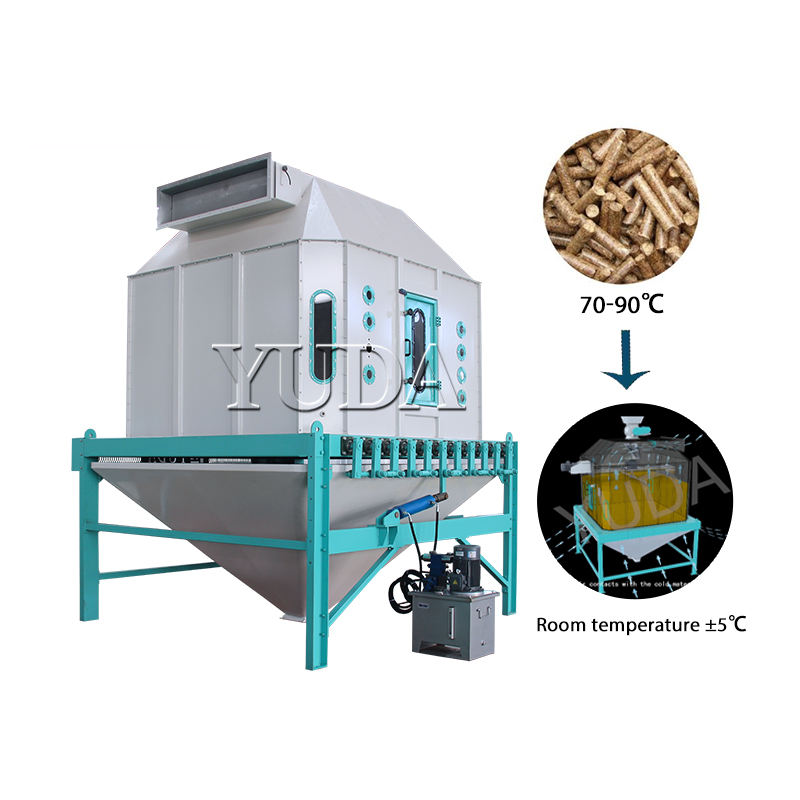
Reducing feed milling electricity costs with counterflow cooling is huge. The second biggest component of the operating cost of any feed mill is energy, with no area greater than cooling your finished feed products. While pellet mill motors often receive the most attention, significant energy savings can be achieved by selecting an energy-efficient counterflow cooler. This design delivers superior energy efficiency due to its built-in airflow and heat-exchange structure. Shanghai Yuanyuda International Trade Co., Ltd. sees dramatically reduced power consumption per ton for mills that install the SKLN series counterflow cooler compared to those that use other types of coolers. Here is how counterflow coolers reduce operating costs for feed mills:
Lower Airflow Resistance Through a Uniform Pellet Bed
A counterflow cooler keeps pellets forming an even material bed as the pellets pass through the equipment with an upward airflow that goes the full width of the cooler. The pellets travel horizontally from inlet to the discharge end and pass over the cooling air as the hot pellets give up their heat. The upward airflow over a shallow, 3-to-6-inch uniform pellet bed creates a uniform resistance to airflow throughout the cooler, unlike conventional horizontal coolers where pellets move horizontally and fall unevenly on a deep bed of cooling material which causes air channeling and short-circuit airflow.
Because airflow resistance remains low, fans do not require over-sizing, cutting installed horsepower and power consumption per ton of finished pellets, thereby consuming much less horsepower and reducing the electrical usage per ton of feed cooled. Shanghai Yuanyuda International Trade Co., Ltd. optimizes the design of the air inlet and discharge for the SKLN series cooler to maintain pressure at a lower, consistent level.
Optimal Air-to-Pellet Ratio with Minimal Excess Air
With counterflow cooling, hot air is exhausted from the top of the cooling chamber, where it is used to heat the hottest pellets in the cooling zone.
Cool, clean ambient air is supplied to the bottom of the cooler, where the pellets are almost cool enough to be discharged. This contraflow cooling arrangement utilizes the total capacity of air for maximum heat transfer. Consequently, less total air is needed to cool the feed products compared to other cooler types where co-current or cross-flow conditions cause higher volumes of excess air. Since less air is being moved, there is less fan horsepower required. The hot exhaust air from the cooler can be recovered for process heating, further increasing energy efficiency. Shanghai Yuanyuda International Trade Co., Ltd. engineers a system that provides a good range of adjustment to both fan speed and air volumes to maximize cooling efficiency for any pellet quality and ambient conditions.
Reduced Re-cooling and Moisture Re-absorption Losses
If the feed leaving the cooler is too hot or if the moisture content is not uniform (high spots and low spots), the feed may have to be held and either re-cooled or dried in the bin. Secondary re-cooling and drying processes consume electricity, and occasionally steam and compressed air to drive conveying equipment and auxiliary cooling fans. If the product is too cool and dried too low there is additional steam and binder that must be consumed to re-pellet at the next process. The SKLN series cooler provides a highly uniform and effective temperature reduction down to within a few degrees of ambient and with consistent, desirable moisture content of 10% to 12% which can be safely bagged and stored without further processing. Shanghai Yuanyuda International Trade Co., Ltd. highlights that its equipment can stably reach ideal discharge temperatures and uniform moisture levels and moisture prevents costly downstream equipment from running unnecessarily.
Longer Equipment Life and Lower Maintenance Energy Penalties
Any cooler's operation will be affected by any fan friction that is caused by either buildup of condensates or fines on its fan blades. In a conventional cooler design, fine product is allowed to travel with the pellets to be screened or passed through. In a counterflow cooler design, the fines are not encouraged to travel long distances and remain relatively close to their entry points, where they can be readily removed through a dedicated fine removal systems without recirculating. The smooth interior construction of the Shanghai Yuanyuda International Trade Co., Ltd. SKLN series cooler, and the efficient and smooth transfer of the product column from inlet to discharge prevent excessive wear on the internal moving parts of the cooler, including the discharge rotor and its drives. By preventing material buildup and optimizing airflow, the SKLN cooler reduces load on all moving components and fan motors and the fan motor for longer life and lower maintenance energy penalties. Energy-efficient feed production lowers operating costs and carbon emissions is crucial to maintain margins and a lower carbon footprint. For energy-efficient counterflow cooling solutions, look to Shanghai Yuanyuda International Trade Co., Ltd. and the SKLN series. Contact us today for a custom cooling evaluation for your feed mill.
