
 EN
EN


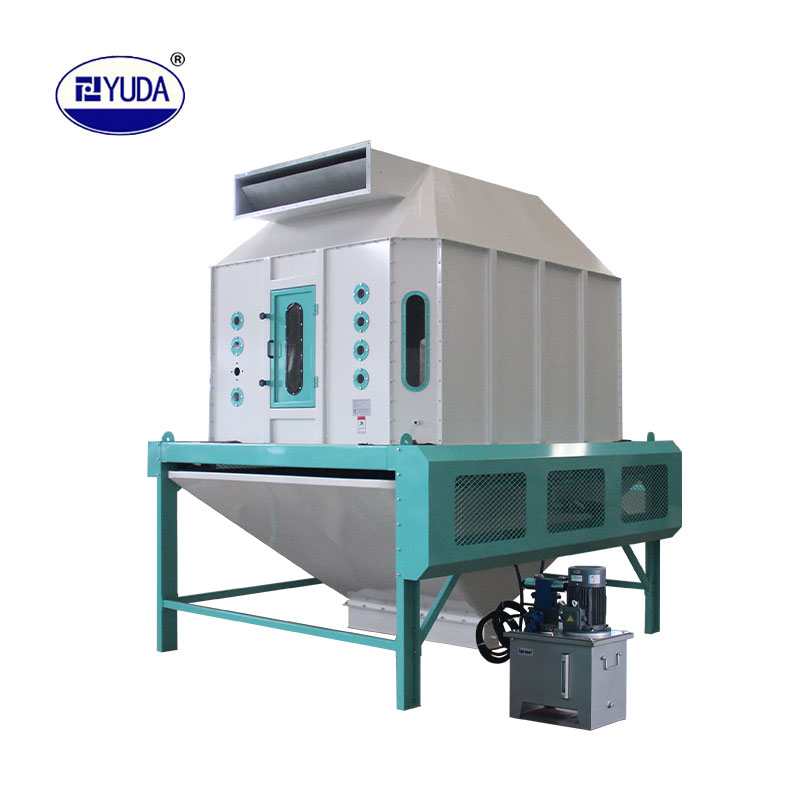
The moment hot pellets are discharged from the pellet mill, they must be cooled. Without the correct pellet cooler, the pellets are soft and brittle, cracking and potentially becoming moldy when stored. A counter flow cooler is the industry standard. This article explains why such equipment is essential for modern feed production lines.
What Is a Counter Flow Cooler and How Does It Work?
A counter flow cooler is a vertically oriented cooling device where a downward flowing column of pellets is simultaneously passed through an upward flowing column of ambient air. Pellets are conveyed to the top of the cooler via a rotary valve or feed chute. Gravity then takes them downward, where they eventually encounter upward moving cool ambient air that enters through adjustable air inlets at the bottom. That counter-direction flow / counter-flow design is where the cooler gets its name. The crucial benefit of the counter flow cooling process is that it creates temperature differences within the cooler column. The coldest, and therefore driest, air meets the coldest pellets just prior to leaving the discharge rotor; meanwhile, the hottest and most moisture-laden air meets the hottest pellets entering at the top of the column. This allows pellet temperature to drop gradually in stages, instead of exposing pellets to an abrupt cold air blast that causes thermal shock. The residence time of the pellets is controlled by a rotating discharge rotor at the bottom of the cooler, the speed of which is variable to alter how long the pellets dwell within the cooler.
Benefits of Counter Flow Cooling in Feed Pellet Production
Counter flow cooling has several advantages over other types of pellet coolers:
Energy Efficiency: Because there is a uniform distribution of ambient air passing through the entire pellet column throughout the cooler height, the quantity of ambient air needed is far less compared to other designs in order to achieve the desired temperature drop. Smaller fan sizes mean lower power consumption. Dust Control: Since it is an enclosed unit, any fines generated at the discharge rotor can easily be captured with a single pulse dust collector hooked to an exhaust port; The result is a clean working environment. Reduced Pellet Damage: Counter flow coolers gently process pellets. Unlike some tumblers and vibratory coolers that are harsh and potentially break the pellet, gravity slowly moves the product down through a column of rising ambient air; no physical mechanism contacts the fragile pellets. Capacity Range: Units exist for every need ranging from aquatic feed production facilities to livestock feed plants; there is a cooler available for just about any capacity requirement ranging from a few tons per hour up to over 100 tons per hour.
How Proper Cooling Improves Pellet Quality and Storage Life
It is not solely about bringing the pellet down in temperature; the goal is to remove free moisture, thus stabilizing the pellet structure. The instant a hot pellet exits the pellet mill**,** it retains surface moisture, and it will hold this and potentially condense if placed directly into a bag or hopper. These pellets will become moldy and stick to each other and bag material. Properly cooled pellets, for example, have a temperature that is not more than five degrees Celsius different from the ambient temperature, and their free moisture has been removed down to typically 12% to 13%. Steady-controlled cooling allows pellet structures to fully set and internal starch to stay gelatinized. When this process occurs correctly the surface of the pellet is properly firmed and will not crack easily. Pellets that have cracks are not just unattractive. Cracked pellets will readily break apart and produce fines which are costly waste. A well cooled pellet will endure being conveyed into a silo or bin without breaking up. This increases their storability and shelf life.
Factors to Consider When Choosing a Counter Flow Cooler
First, select the capacity you require. If your pellet mill runs at 100 tons per hour at peak production**,** you should over-specify the cooler to allow for any production downtime or fluctuations in mill capacity, but not over-specify so much that the cooler is too big for even proper air distribution. Pellet size and density are another major factor. Large diameter pellets require a much longer retention time to cool adequately than small diameter pellets. Aquatic feed pellets, for instance, require shorter retention time but higher airflow than livestock feed pellets, depending on the product density and dimensions. Material moisture content is another variable to consider as higher initial moisture will necessitate either longer retention times or greater airflow or both. The available floor space will dictate what you can purchase; the cooler itself is tall compared to its footprint. Make sure you have adequate height for the chosen unit and a door or entryway large enough to accommodate it. Accessibility to certain components affects your ability to maintain and troubleshoot your cooler. Ensure there are observation doors at multiple points, that the discharge rotor can be easily removed, and that air inlets are accessible. The quality of the materials used to construct the cooler will also affect its lifespan and resistance to damage, especially since corrosive feed materials can cause deterioration unless suitable construction materials are used. This is especially true for fertilizer applications where the feed materials are very corrosive. Finally, consider how well the cooler will integrate into the balance of your feed production line. If the pellet mill output exceeds the cooler’s processing capacity, you need a larger cooler or additional pellet mills. Shanghai Yuanyuda International Trade Co., Ltd. offers an extensive line of SKLN counter flow cooler products of the highest quality, certified to international standards and designed to meet the capacity and quality demands of feed manufacturers.
Summary
The counter flow pellet cooler is indispensable in any modern feed production line that is seeking to optimize pellet quality and storage longevity. Gentle processing of the pellet prevents structural damage, while simultaneous movement through columns of ambient air cools them evenly and efficiently, at reduced energy cost relative to many other pellet cooling technologies. Proper conditioning, drying and cooling are key steps to producing products with a long shelf life. that resists damage and potential for mold growth. When selecting a pellet cooling unit, capacity, pellet dimensions and moisture content, floor space, ease of maintenance, durability of construction materials, and ease of integration into existing production facilities will be your most important considerations.
